


Clarks from Somerset to the world
Established in Somerset, England, Clarks has been a shoemaking pioneer since 1825. Founding brothers Cyrus and James Clark created their first style using a radical combination of innovation and craftsmanship that remains at the heart of everything we do today. Still rooted in the Somerset countryside where it all began, Clarks Headquarters nestles in the shadow of the Glastonbury Tor – a local landmark with a longstanding connection to Clarks that has featured as a stamp of quality throughoutit’s rich 200-year history.

Jasper Krabbé
Jasper Krabbé trained at the Rietveld Academie in Amsterdam, where he graduated cum laude in 1992. He continued his studies at the Cooper Union in New York, one of the oldest and most prestigious educational institutions in the US. Since 1999, his work has been on regular display in the Netherlands and elsewhere.
He has had solo shows in Rome (2RC Gallery), New York (Brenda Taylor Gallery), São Paolo (Nara Roesler Gallery) and the Netherlands (Museum Belvédère, Tropenmuseum, Kunsthal). His work has featured in group exhibitions and at art fairs in Basel, Berlin, Madrid, Miami, Trieste. Works in the collection of De Nederlandse Bank and Stedelijk Museum Amsterdam and many international private collections.
Currently, he is working on CLOUDS, a forthcoming publication about his installations of drawings — large constellations in which individual works, made across different places and moments in time, come together as a visual diary. The book will be published by Uitgeverij Komma in early 2027.
Clarks and Atelier Krabbé
Jasper Krabbé began as a graffiti writer.
The street was his first canvas.
Clarks is the most iconic shoe brand in the world,
mastering street culture worldwide for over 200 years.
Naturally these two stories go together.
For this cross-over project Atelier Krabbé created 7 unique pieces of art, with Clarks shoes as a canvas.


CROCKERS OF GLASTONBURY
This pair circles back to Somerset — the landscape where the story of Clarks began.
But the Crockers I imagined are a slightly different breed.
Traders, hustlers and characters operating somewhere between the market stall, the back room and the street. Buying, selling, swapping — records, clothes, whatever could be moved. Deals made by hand, music playing somewhere nearby.
I imagined them moving through Glastonbury in well-worn Clarks: part businessman, part outlaw, part counterculture.
The drawings and colours grew out of that imagined world — layered, rough around the edges and constantly in motion.
Not quite businessmen. Not quite outlaws.
Crockers.
7000 EICHEN (FOR BEUYS)
This pair was conceived as a quiet homage to Joseph Beuys.
I first encountered the work almost by accident: five basalt stones embedded in 22nd Street in Chelsea, resting among the concrete and movement of Manhattan. I was baffled by them. They seemed strangely out of time — like ancient monoliths dropped into the rhythm of the city.
The stones turned out to be part of Joseph Beuys’ legendary 7000 Eichen project.
Originally conceived for Documenta 7 in Kassel, the work consisted of 7,000 basalt stones, each connected to the planting of an oak tree. It was a radical proposition in which sculpture, ecology and everyday life became inseparable.
Years later, the memory of those stones resurfaced while I was painting this pair of Clarks Desert Boots. The choice of the shoe itself is a nod to Beuys, whose unmistakable appearance — felt hat, fishing vest and sturdy, utilitarian boots — became almost inseparable from his artistic identity.
For me, Beuys’ basalt stones carry an almost sacred sense of permanence — silent markers of time, nature and human intervention within an ever-changing world.


HIGH ROLLER
This pair of Wallabees draws directly on my street origins.
On one side, a skater cuts through the concrete of an abandoned pool. On the other, a writer hits a passing freight wagon with a roller. Working at night meant fast hands and alert eyes. There were no second chances.
Numbers, fragments, tags and time stamps appear like coded messages — a language built in motion. Executed in dust, oxidized blue and faded grey, the pair was painted with the same speed and impulse.
As a young writer, I — under the moniker JAZ — painted hundreds of pieces: on trains and trams, underpasses and bridges, freight cars, construction cabins and rooftops. Night runs, police chases, paint in the lungs: adrenaline as raw material.
What began in the street gradually evolved into a studio practice, but the energy never disappeared. The speed, improvisation and instinct of those years remain embedded in the way I work today.
High Roller stands as both artifact and testimony — tracing a line from the street to the studio and back again.
The tool, the risk, the roll of the dice.
L STITCH / BANK ROBBER
“Down in Jamaica we call that Clarks the bank robber. But in England it’s called the L Stitch.”
In Jamaica, Clarks is part of reggae culture, dancehall and rude-boy style. The shoes are still everywhere — in the streets, in the dancehall, on record covers and in lyrics.
This pair is an ode to the Rude Boys and the music that came with them — from ska and rocksteady to reggae, dancehall and sound-system culture.
Clarks’ Desert Trek even got its own Jamaican nickname: Bank Robber. The little Trek Man on the shoe, walking with a bag on his back, was seen as a robber making his getaway with a bag of money. Clarks became so closely associated with rude boys that wearing a pair could attract the attention of the police. It reminds me of growing up doing graffiti in Amsterdam, where cops would check our clothes and shoes for fresh paint splatters.
That connection between music, the street and the shoe was my starting point.
I painted the pair almost like one would build a sound system: layers of colour, signs, figures and fragments stacked on top of each other. Music runs throughout the shoes. On one of the hanging fobs I painted a Jamaican sound system — handmade stacks of speakers built to fill the street with heavy bass.


KYOTO
Japan has occupied a place in my imagination for a long time. Years before I first travelled there, I already made a series of paintings inspired by Japan.
In February 2026 I finally spent several weeks travelling and drawing there. This pair grew out of that journey and is an ode to Kyoto — its culture, craftsmanship and deep sense of history.
I drew wherever I went: people on the subway, cooks, trees supported by bamboo, temples, gardens, signs and fragments of everyday life. Visiting the Zen garden of Ryōan-ji, a place I had wanted to see for years, became one of the anchors of the trip.
Those observations found their way onto the Clarks: drawings, signs, colours and fragments layered across the shoes — a small Kyoto Cloud in itself.
THE guests at the CONDOR BAR — OJAI↗️LA
This pair is dedicated to the Condor Bar in Ojai, Ca.
Only a couple of hours from Los Angeles, Ojai feels like another world. You leave the city behind and drive into a valley surrounded by mountains, orange groves, hiking trails and natural swimming holes.
It has long attracted artists, musicians and other creative people — a place to escape, meet, exchange ideas and spend time in nature.
The Condor Bar captures that spirit. Named after the California condor, it became our meeting place in Ojai. My friend Peter manages the restaurant and bar and appears here in bright pink, wearing his unmistakable hat.
The colours and drawings came from that experience: the road from LA, the landscape, the people, the heat, the water — and the condor somewhere above it all.


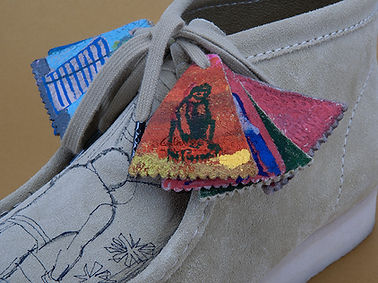

FOR DAVID HOCKNEY
Even though I’m not quite sure Hockney ever wore a pair himself, these Wallys are dedicated to him.
Of the seven unique Clarks Originals I made for this project, this is the quietest — almost entirely black and white, drawn directly onto the shoe with fine lines. The drawings reference Hockney’s world: a palm tree, Sunset Boulevard, Los Angeles, his garden, and an image loosely based on one of his early paintings.
My connection to Hockney is also personal. In 2019, I was supposed to interview him for Dutch television in Amsterdam. On our way to the interview, Hockney, my camera crew and I got stuck in an overloaded elevator at the Conservatorium Hotel.
For forty minutes.
I gave him my book and we talked about painting and drawing. When we finally got out, the hotel offered him a suite, dinner — whatever he wanted. His answer was simply:
“I just wanna smoke.”
What I have always admired most in Hockney is his drawing: looking at the world and translating it into line. Immediate, vulnerable and seemingly simple.
That is why this Wallabee is different from the other six. It is less about decorating the shoe and more about drawing on it.
A wearable drawing — and a tribute to one of the great observers.
For David Hockney
1937–2026